
Students at the University of Maryland Baltimore County are documenting the beliefs, relationships, and practices that shape their lives. Through it, they are testing whether photography can help turn religious diversity into pluralism.
By Kyle Desrosiers-Levine
BALTIMORE (RNS) — At a table with other University of Maryland students and campus leaders, Keven Guruswamy, a senior psychology major and Seventh-day Adventist, held up a photograph of his collection of Bibles arranged on a shelf.
Some of the Bibles were in Tamil, others in English. Some he acquired himself, and others were gifts, including from his grandmother, who has since died. He said his experience growing up in a religiously mixed family — which includes Hindus and Christians — introduced him to “the beauty of interfaith cooperation.”
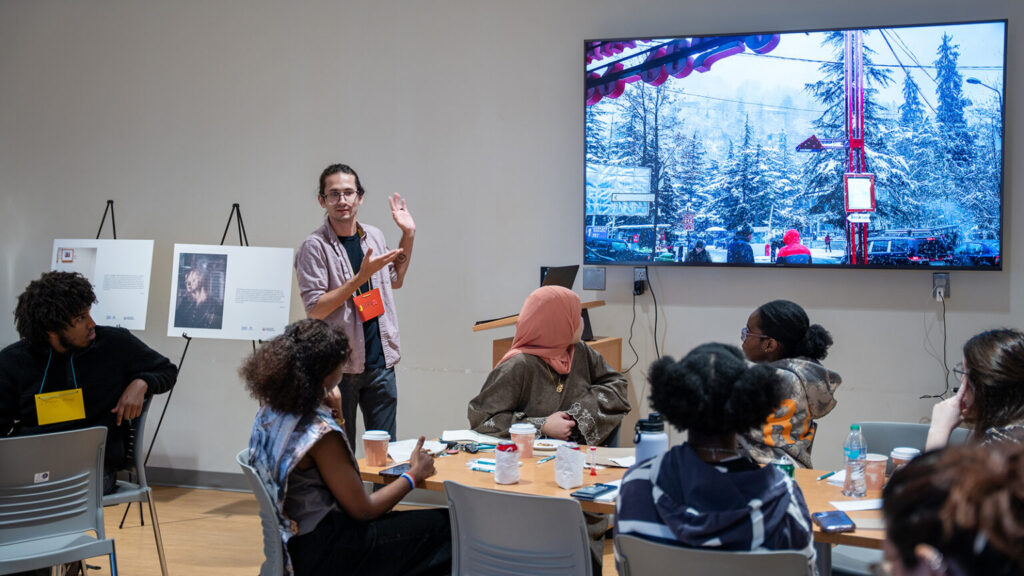
Guruswamy brought the photo to a two-day retreat in mid-October as part of “Picturing Pluralism,” a semester-long photography and dialogue project bringing together about 30 University of Maryland Baltimore County students and 10 faculty and staff. In a fraught national political climate for college students, the goal is to create an experience on a religiously diverse campus that leads to meaningful connections.
Faculty interviewed by RNS described UMBC as one of the country’s “most religiously diverse campuses,” pointing to a student culture spanning multiple branches of Christianity and Islam as well as Jewish, Sikh, and Dharmic groups. For example, student groups have recently hosted a Muslim women’s fellowship, a Sikh festival, a queer Orthodox Jewish gathering, and a South Asian Christian organization, according to photography project organizers and participants.
Yet the university, founded in the 1960s and which today enrolls about 13,530 students, lacks some of the religious infrastructure found on other college campuses, said Matt Hoffman, director of the Center for Religion, Spirituality and Pluralism on campus. UMBC has no formal chapel, and demand for prayer and religious practice space means different communities use the same facilities.
On Fridays, the Center for Religion, Spirituality and Pluralism’s multi-use hall can become particularly busy. Muslim students use prayer mats and dividers for gender-separated prayer; Catholic students hold rosary gatherings and worship music sessions, and Jewish students meet for Shabbat dinners and prayer services.
Sometimes Lisa Huberman, the social action engagement associate at UMBC Hillel, arrives with Jewish students preparing for a Friday evening gathering while Muslim students are concluding their prayers.
“It’s very much like a delicate dance,” Huberman said. “Even just basic functions of existing, even in a mundane way, we’re always negotiating. But it also means there is an opportunity to encounter difference in close proximity at UMBC.”
And the project comes as colleges remain flashpoints in national disputes over identity, free speech, and inclusion. Several days before the photography retreat, students held vigils, both to remember the victims of the Hamas attack on Israel on Oct. 7, 2023, and to protest the ensuing war in Gaza.
While organizers said they were sensitive to this dynamic and prepared for potential conflicts, Huberman and Hoffman said they’ve also begun to see this proximity as an opportunity.
“The next level,” Hoffman said, is to ask, “What do we do with the diversity?”
Enter ‘Picturing Pluralism’
“Picturing Pluralism” is a partnership between UMBC’s Center for Religion, Spirituality and Pluralism and Interfaith Photovoice, an organization that combines amateur photography with structured dialogue across religious, spiritual, and cultural differences.
Joshua Polanski, Interfaith Photovoice’s director of engagement, said his organization has reached multicultural communities, from Michigan to Oman to Pakistan to Texas, in settings from corporate spaces to higher education.
The goal is to “take someone that is maybe even barely an acquaintance and shift that relationship into something where they’re gaining knowledge,” said Roman R. Williams, founder of Interfaith Photovoice and a visual sociologist.
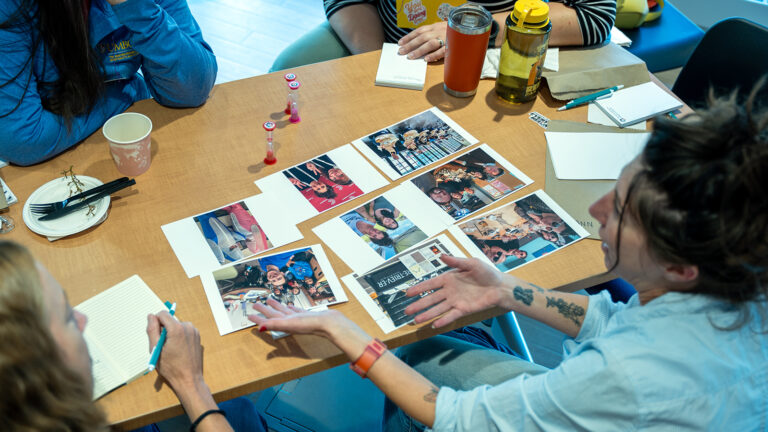
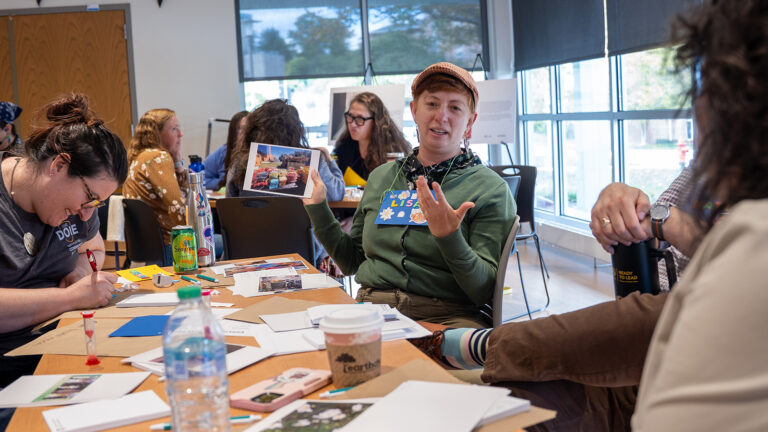
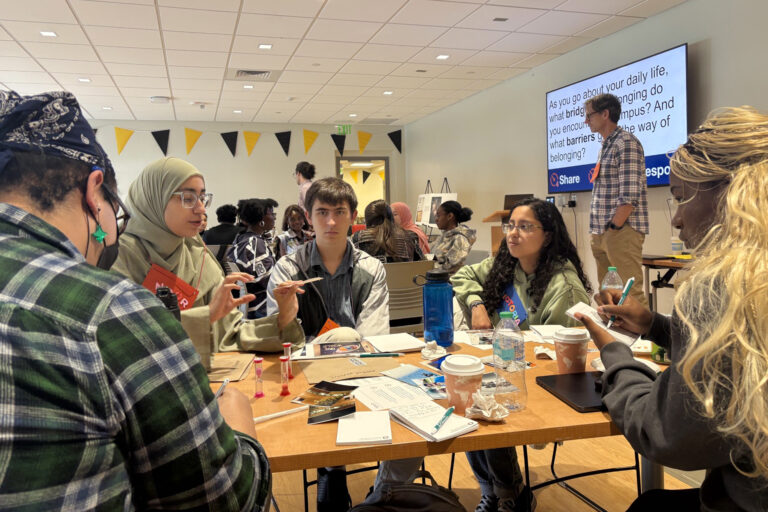
The retreat took place during the university’s fall break, making the already commuter-heavy campus even quieter. Inside the same multi-use hall where religious services are held, participants sat around tables with five or six others. They showed personal photos, perhaps depicting a prayer practice, an object, a landscape, or a relationship. They then responded to prompts about belief, belonging, and barriers on campus.
Each spoke for four minutes while others listened. The group then asked questions and gave each speaker time to consider them before responding.
While the students in the room seemed hesitant at first to share, many became louder and more enthusiastic as conversations progressed. Some became tearful as they shared vulnerable reflections.
A Palestinian American student shared a self-portrait intended to explore her identity at an especially fraught and difficult moment, noting she’d spent many years feeling either “too Palestinian to be American, or too American to be Palestinian.”
Guruswamy said the experience represented a shift from “cultural competence” toward “cultural humility.” The process “allows you the opportunity to be humble with one another,” he said.
Onkarpreet Kaur, a second-year microbiology student, shared a photograph of the kara she has worn for six years. The circular steel or iron bracelet is one of the five articles of faith traditionally associated with Sikhi. Kaur said its circular form represents continuity, but it also reminds her of the physical distance she sometimes feels from Sikhi as a member of the diaspora, far from the faith’s historic center in Punjab, India. She has kept the same kara partly because she does not know where to buy another near campus.
“It just reminds me of my values,” Kaur said. “It helps me get to the right path.”
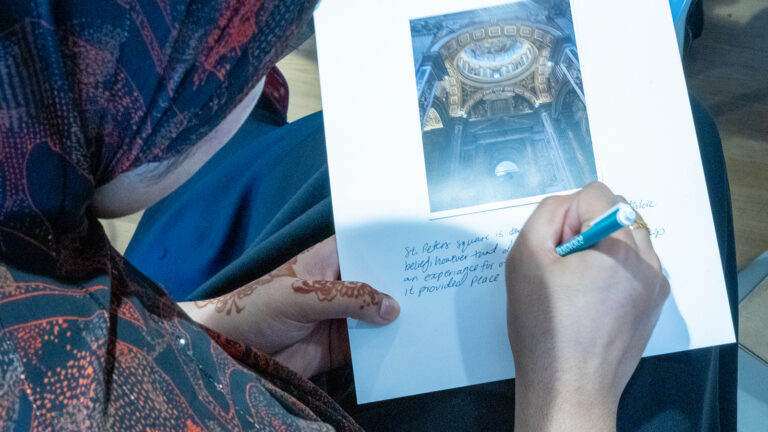
Fatima Hafeez, a second-year political science student, shared a photograph of St. Peter’s Basilica in Vatican City. She said she admired the devotion of Catholics who traveled there and connected their journeys to the Muslim pilgrimages of Hajj and Umrah, which she has undertaken herself.
“I love to hear what people think, how they process things,” Hafeez said. “It’s really easy to group people together,” she added, but listening to personal stories reminds us that “everyone is a human with their own individual experience.”
The impact
Duncan Winger, a second-year student creating an interdisciplinary course of study around what he calls “holistic learning,” said the experience changed how he viewed ordinary scenes across campus.
One participant described praying while taking a daily walk. Winger, who grew up in an atheist family and described himself as agnostic, said that made him realize he could pass someone walking across campus without knowing what that person was experiencing internally.
That recognition, Winger said, “opens up empathy.” It also taught him he didn’t need to understand every aspect of another person’s religion before engaging them. “I can still ask and be curious,” he said.
Velma Funebe, a senior majoring in public health, said the experience made her reconsider how she communicates her Christian faith. On LinkedIn, she sometimes shares written reflections about religion and spirituality. The retreat made her wonder whether photographs could communicate more about her faith.
“I think people can take so much from just a picture,” she said.
At the same time, as the Trump administration’s mass deportation agenda has swept across American cities, some students who were not born in the United States were cautious about being interviewed or photographed. Some shared photographs and explanations that touched on questions about immigration status and fear.
Whether the encounters will produce lasting institutional change remains an open question. The project doesn’t provide proof that photography can resolve campus polarization.
But Abdul Samad Amjad, a Photovoice facilitator and scholar of community-based participatory research who was born in Pakistan and lives in Ohio, said the method gives participants a role in defining problems and possible solutions.
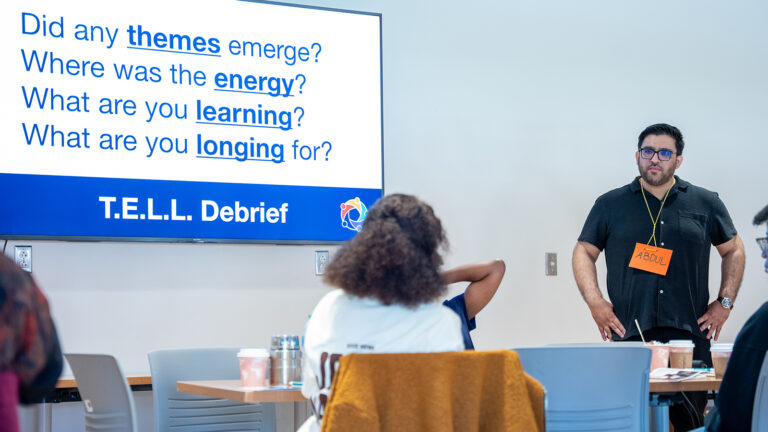
“There are different stories being told,” Amjad said. “But at the end, what I’d realize, there is always this story of us, that collective story. Our shared humanity gets represented there.”
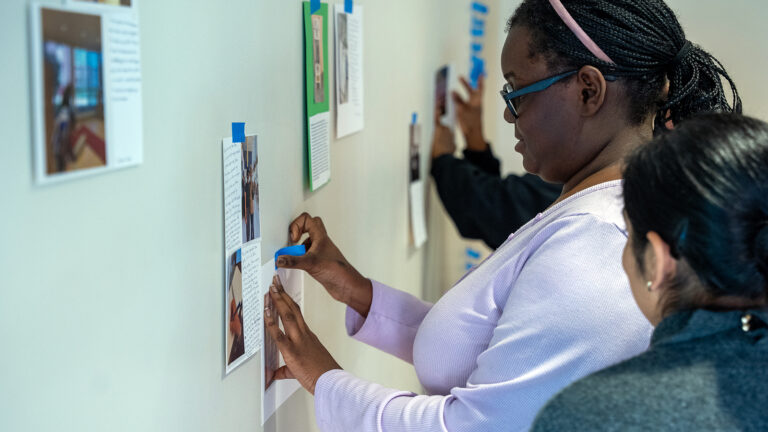
On the retreat’s second day, participants began turning those individual stories into a collective exhibition. Each selected a photograph they considered essential, then the group examined the collection and asked what was missing.
Participants then developed captions.
The exhibition is scheduled to open Dec. 2 in UMBC’s Albin O. Kuhn Library and Gallery, presenting the students’ account of belonging, unmet needs, and the campus participants hope to build.
“My dream is that these spaces can be more beyond campus, too, and that we can all be more interconnected, to just be human with each other in rooms, across difference,” Winger said.
Kaur has experienced one of those changes herself. She came to UMBC unsure of how people with different beliefs could live together. Some of those people, she said, are now among her closest friends.
“We are living in the same space with different beliefs,” Kaur said. “We coexist but we are not blending with each other. We have our own identity, and it is so beautiful.”
Williams cautioned against treating such encounters as proof that photography can overcome all the divisions participants bring into the room. Building relationships takes longer, he said.
“It’s a theory of change, but we see it happen,” he said. “Sometimes in very small ways.”
The RNS Love Thy Neighbor series is made possible by support from Faith in Public Life, Garrett-Evangelical Theological Seminary, the Center for Congregations, The Fetzer Institute, and readers like you. Support this work with a gift today.
First published October 27, 2026